If you have searched for thunderstruck wood meaning — or lightning struck wood meaning and lightning struck wood folklore — you are usually looking for a cultural explanation, not a botanical one. In Chinese the wood is called leiji mu (雷击木), and in older writing pili mu (霹雳木, “thunderclap wood”). It is not a species, but an event: a living tree marked by lightning, later kept or carved as a keepsake. The stories belong to Chinese folk tradition and Daoist ritual history.
Shared as cultural folklore; no protective or healing effect is claimed.
What “thunderstruck wood” means
Thunderstruck wood, also called lightning-struck wood, is timber from a tree that lightning hit. In Chinese folk tradition, people did not treat every burned log the same way. Stories often distinguish a tree that was simply destroyed from one that was struck and still lived. Workshop lore still holds that the valued material came from a tree that survived the strike and kept growing — a traditional description, not a laboratory test.
Thunder appears in Chinese popular religion as forceful weather associated with the sky. In that storytelling world, a tree that met the storm and remained standing was taken as a marked, scarce object. People believed, in that tradition, that the mark of thunder stayed in the grain. We do not claim that it does.
How the idea appears in Daoist and historical records
A clear written trail appears in Li Shizhen’s Ming dynasty Bencao Gangmu (Compendium of Materia Medica), in the wood entry for zhenshao mu (震烧木), also named pili mu. Li writes that this is “wood struck by thunder,” and that fangshi — ritual specialists — carved it into talisman seals. He is recording a practice and a belief, not proving a hidden power in the timber. The same entry draws on Chen Cangqi’s earlier Bencao Shiyi, which mentions hanging such wood at a doorway in connection with stories about fire. That is a remark about a folk custom, not a guarantee.
In his seventeenth-century Wuli Xiaoshi (Notes on the Principles of Things), Fang Yizhi notes that Daoist priests made lingpai, or command plaques, from lightning-struck jujube wood, commenting on the hard red heartwood and on the belief that the strike had marked the timber. Modern scholarship on Daoist seals likewise notes that preferred materials began with stone and metal and later included wood struck by lightning. Song-dynasty communities also developed the Thunder Rites (Leifa, 雷法), which helps explain why the stories endured. That is a record of how people thought and carved, not evidence of a physical effect stored in the wood.
Peach wood, jujube wood, and lightning
Searches for peach wood lightning usually bring two traditions together.
Peach wood (taomu, 桃木) has its own door-and-new-year folklore, with or without a lightning strike. Ying Shao’s Eastern Han Fengsu Tongyi (Comprehensive Meaning of Customs) retells the legend of the brothers Shentu and Yulei, who watched over spirits beneath a great peach tree. The sixth-century Jingchu Suishi Ji records peach boards placed on doors at the lunar new year, sometimes called “immortal wood” (xianmu). Later texts often describe peach as “the essence of the five woods.” In Chinese folk tradition, people believed peach wood at the threshold belonged to that story-world. That is a recorded custom, not a claim made for any product.
Jujube wood (zaomu, 枣木; Ziziphus jujuba) is the species most often named in Daoist craft notes: a common, non-endangered fruit tree with dense reddish heartwood. When workshop sources speak of thunderstruck wood for seals or plaques, they most often mean lightning-struck jujube. Nestlyo’s pieces are carved from jujube described by the workshop as lightning-struck, not from peach wood.
Why the wood was considered rare
Lightning is ordinary weather. Usable thunderstruck wood is not. A strike may shatter a trunk, burn it past carving, or leave no clear mark in a workable piece. Traditional accounts treat the material as scarce for that reason, and Nestlyo’s legend page describes carvers waiting for the storm rather than cutting a living tree for this wood. There is no reliable historical figure for “one tree in so many,” and this article does not invent one.
How people tried to identify a real strike
Appearance alone cannot scientifically certify a strike, but lightning and an ordinary flame do not mark wood in the same way.
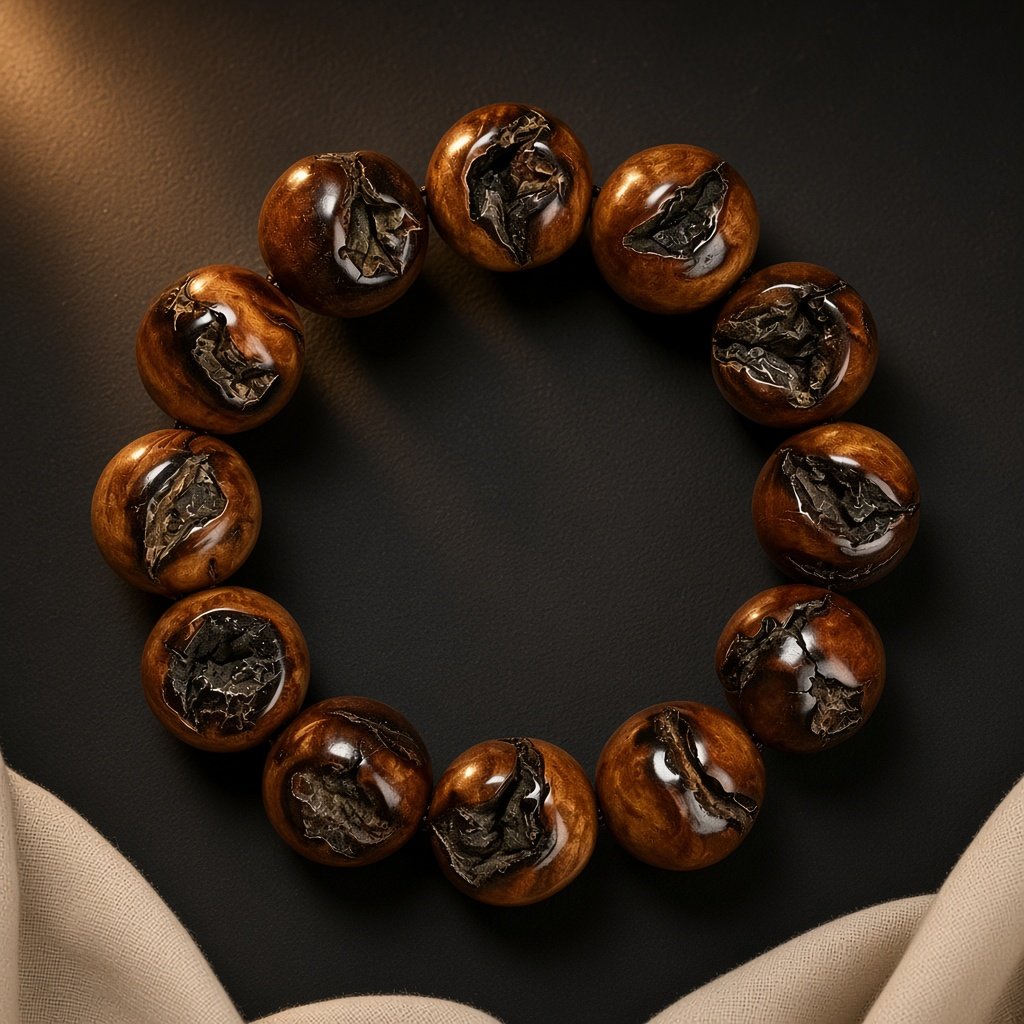
When lightning hits a living tree, moisture in the trunk can vaporize in an instant. The sudden expansion often splits the wood and leaves darkened scorch lines that travel with the grain. In pieces people have taken to be genuine, the marks start inside the wood and move outward, rather than sitting as a flat black skin; run deep enough that a worn face still shows the line; fade from darker char into the heartwood; and branch irregularly. A uniform surface scorch, or identical repeated lines, is more consistent with torching — a visual caution, not a courtroom test.
Jujube heartwood is naturally dense, so a water-sink test says more about species and age than about lightning. Look at the depth and irregularity of the scorch lines, ask what species the wood is, and treat any story about the strike as a story unless the source is documented. Nestlyo describes its timber as lightning-struck jujube from Fujian and Hebei, and leaves the scorch lines visible in the finished grain.
Bracelets, charms, and threshold gifts today
The old uses were ritual and domestic: seals, command plaques, a piece hung at a door or carried. Contemporary keepsakes follow those shapes without repeating older claims as facts.
Nestlyo’s Strike Bracelet and Thunder Thread Bracelet are hand-carved from that jujube wood, with the strike marks kept rather than sanded away. A carved hanging piece is often a key or car charm. Because so many of the stories gather at the doorway, The Threshold Box gathers a door charm and bracelets in one housewarming gift, with a legend card that tells the story as tradition.
You can browse Nestlyo’s lightning-struck wood keepsakes, or read a shorter telling on the legend of lightning-struck wood. The pieces are decorative and cultural.
Shared as cultural folklore; no protective or healing effect is claimed.
FAQ
What does thunderstruck wood mean?
Thunderstruck wood — leiji mu in Chinese — means wood from a tree marked by a lightning strike. In Chinese folk tradition, people told stories about that event and the grain it left. The phrase names an event, not a tree species.
Is “lightning struck wood meaning” the same as “thunderstruck wood meaning”?
Yes. The two phrases refer to the same material and folklore. English sources use both. Chinese sources most often use 雷击木, with 霹雳木 as an older literary name.
What is the folklore around peach wood and lightning?
Peach wood already had a door-and-new-year tradition in Chinese folklore, recorded in Fengsu Tongyi and Jingchu Suishi Ji. “Peach wood lightning” usually combines that tradition with the separate idea of thunder-marked timber. Nestlyo’s carvings use jujube wood, which Daoist craft notes often preferred for seals and plaques.
How can you tell if wood was really struck by lightning?
There is no perfect visual test. Look for irregular, branching scorch lines that enter the grain and fade naturally, not a flat burned surface. Jujube is naturally dense, so a water-sink test does not prove a strike.
Does thunderstruck wood protect a home or bring luck?
No such effect is claimed here, and none should be inferred from the folklore. In Chinese folk tradition, people believed stories of that kind and made ritual objects accordingly. Nestlyo pieces are decorative cultural keepsakes. Shared as cultural folklore; no protective or healing effect is claimed.